It is common for employees to have conflicts with their co-workers. There may be conflicts due to individual differences between co-workers. In addition, there could be task-related conflicts arising from leadership or company policies. In any case, resolving conflicts in the workplace is important. Workplace conflicts are not desirable for either company performance or individual well-being. Let us look at Thomas Kilmann’s Conflict Model to resolve conflicts in the workplace.
Let us consider an example to understand the process of conflict resolution in the workplace. Company ABC has been merged with company XYZ. The top management team of ABC wants to print posters containing the name and picture of their Founder and CEO and have them put up in all departments across both organizations. Company XYZ sees this as an intrusion and also considers it a waste of resources. However, ABC, being the more reputable and revenue-generating of the two firms, thinks and insists that this move is required to boost the morale of both firms.
Contents
The Thomas Kilmann Conflict Model
Thomas and Kilmann’s Conflict Model is a powerful way of looking at conflict management. Conflicts are painful for individuals, and it is an important test of managerial skills. Different people respond differently to conflicts. Thomas and Kilmann studied how people managed conflicts. They were greatly inspired by the daily lives of individuals. They observed that most people use one of the five approaches to resolving interpersonal conflicts. Kenneth Thomas and Ralph Kilmann developed a framework using these five approaches. They came up with the Thomas-Kilmann Conflict Mode Instrument or TKI in 1974.
However, let us first understand the nuts and bolts of TKI. Firstly, TKI talks about the two dimensions of conflict management. Think of them as two approaches that you can take. You could be assertive in resolving the conflict or try to be cooperative.
What’s Your Conflict Style?
12 workplace scenarios · 3 minutes · based on the Thomas–Kilmann framework
Two Differing Approaches – Assertiveness vs Cooperativeness
The Thomas Kilman Conflict Model posits that there are two ‘dimensions’ or approaches for conflict behavior. These approaches are essentially ways of dealing with the situation of conflict. The individuals may choose to be either assertive in their approach or cooperative.
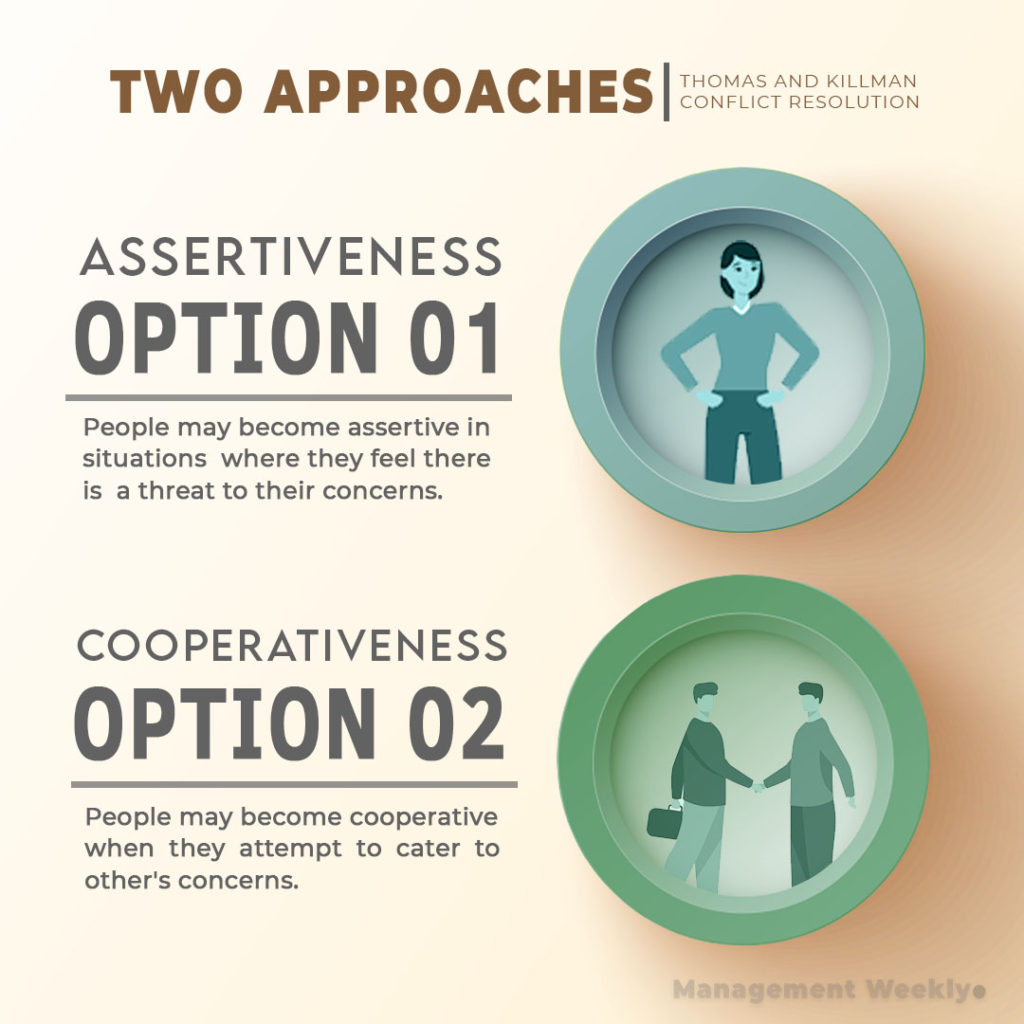
People may become assertive in situations where they feel there is a threat to their concerns. On the other hand, they may become cooperative when they attempt to cater to other’s concerns. These dimensions provide us with a perspective to understand the five modes for managing conflict. Finally, it should be noted that T&K has emphasized that no one approach is superior. A manager should use an approach as per the situation. I have attempted to provide a summary of the two approaches below for easier perusal:
[table id=6 /]
The Five Modes for Conflict Management
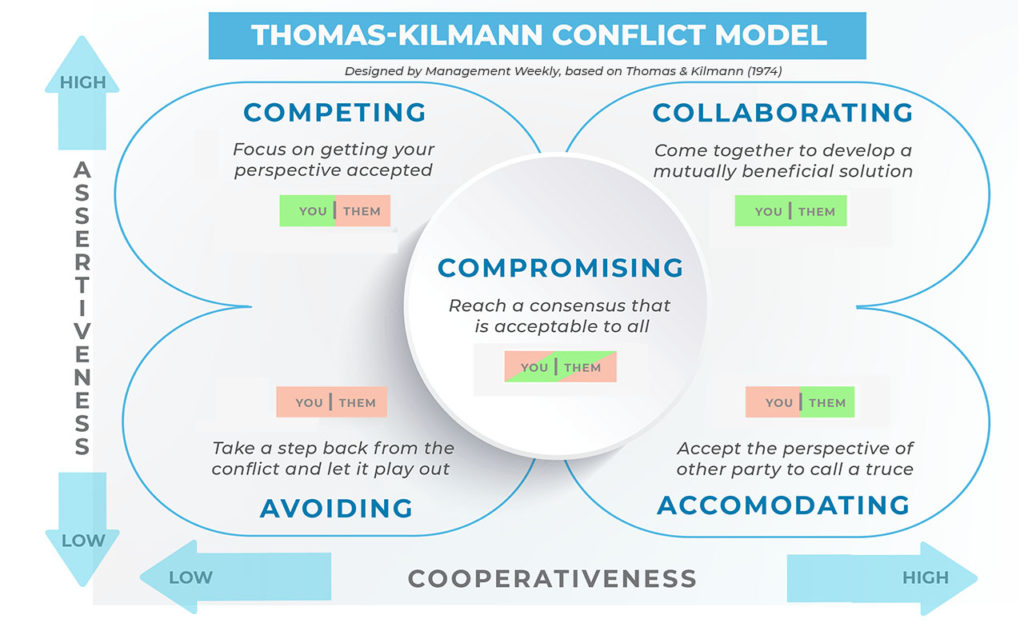
The five modes for conflict management are the core takeaway from Thomas Kilmann’s conflict model. These modes are spread across the two dimensions or approaches as we have discussed earlier. Let us first place them in a chart. This will help us make a better sense of the model. Further, we shall take a deeper dive into each one of these modes.
1. Competing
At the top left end of the chart, we have high assertiveness and low cooperation. We find competing right at this spot. This means that we use ‘competing’ as a conflict resolution strategy when we resort to being assertive. Additionally, we also become uncooperative with the opposing party. However, this strategy is not as evil as it sounds. This mode may be more appropriate when we need speedy resolution, and we are in a higher position of power. It is also imperative to use this mode when we have to take tough calls.
Example scenario: The security freeze
A release manager discovers, two days before a major launch, that a third-party library
in the build has a critical vulnerability. Marketing has announced the date; the sales
team has demos booked. In the go/no-go meeting she states plainly: “We ship without this component or we don’t ship. I won’t sign off a known breach risk.”There is no workshop, no split-the-difference. She uses her authority and takes the
unpopularity. Why it works here: the stakes are asymmetric — a delayed launch costs
days, a breach could cost the company. When the downside is catastrophic and time is
short, competing is not aggression; it is stewardship.
2. Avoiding
The avoiding mode reflects passivity in conflict management. Although, from an ideal perspective, we would agree that we should face the problems head-on. However, the most confident of us would have been in situations where confrontation was best avoided. Also, some problems are so trivial that they are not worth your time.
This approach involves shunning the conflict and withholding one’s views and opinions. People also employ this approach when the cost of confrontation and resolution is far more than the cost of living with the conflict. However, avoiding does not resolve the conflict. On the downside, it just buries it below the surface and may potentially lead to future conflicts.
Example scenario: The heated argument
A sprint retrospective turns personal: two engineers start relitigating a production
incident with rising voices. The engineering manager closes the topic: “We’re not solving this in the last five minutes of a Friday retro. I’m taking it off the agenda and I’ll talk to you both Monday.”By Monday, both engineers have cooled off, and the manager has read the incident log —
the facts settle half the argument before it restarts. Why it works here: avoiding
is not pretending the conflict doesn’t exist; it is choosing the timing. Deferring a
fight you’d lose to emotion, to a moment you can win with facts, is a skill.
3. Accommodating
Now, we are gradually moving towards more amicable means of resolving conflicts. Perhaps, accommodating mode is so considerate of the opposing party that you are ready to call it a truce at the cost of giving up your position. It may be worthwhile in situations when the conflict is a total waste of your time.
The Thomas and Kilmann Conflict Model positions this mode as high in cooperativeness and low in assertiveness. We sacrifice our own stance to make the other party happy.
Example scenario: The naming debate
A senior designer has argued for weeks that the new feature should be called “Spaces,”
not “Rooms.” In the final review the product lead — who prefers “Rooms” — realises the
designer’s conviction is deep, the user-testing difference is marginal, and the launch
needs the designer’s full energy far more than it needs the product lead’s preferred noun.“Let’s go with Spaces. You’ve thought about this more than I have.” Why it works here: the issue is minor, the relationship and momentum are major, and conceding
visibly costs the product lead nothing but ego. Accommodating spends a small chip to
buy a large one — and unlike capitulation, it is chosen, said out loud, and banked.
4. Collaborating
We use collaborating mode of conflict resolution when we are on the same page as the opposing party. This is an ideal solution. It happens when both parties are sensible, have similar power and authority, and are ready to cooperate with each other. This is easier in a decentralized organizational structure.
Typically, the first step is a detailed discussion. We need to understand each other’s viewpoints. This leads to a deeper analysis of the situation. We also try to understand each other’s expectations. Finally, we reach a solution where both parties may benefit.
Example scenario: The two different roadmaps
Two product leads both need the only data-engineering team for Q3 — one for a customer
migration, one for a compliance deadline. Instead of escalating, they book two hours,
map both projects’ actual dependencies, and discover the compliance work needs the same
data pipelines the migration would build — just in a different order.They re-sequence into one shared plan and split the engineering time 70/30 across the
quarter. Why it works here: both concerns were legitimate and important, and the
integrated answer was genuinely better than either original ask. That discovery only
happens when both sides put their real constraints on the table.
5. Compromising
Finally, we arrive at the literal middle ground in the Thomas Kilmann Conflict Model. The center of the chart shows us a point where we are moderately assertive and moderately cooperative. In certain situations, we may not want to have an extended resolution. Collaborating takes time. Also, in some situations, we don’t want to be too confrontational, but at the same time, we want to take a stand as well.
Also, there are some conflicting situations where we know that the best potential solution would be to satisfy all the parties. In such situations, we typically approach the conflict as a compromise. Each conflicting party gets something they want. Meanwhile, they also give up something they wanted. So it is a mixed win for all. However, some parties may get a resolution closer to their expectations, while it could be a greater compromise for the other.
Example scenario: The conference budget
Two department heads each want the full training budget for their teams’ conferences.
Both cases are decent; neither is decisive; the budget deadline is Friday. They split
the budget 50/50 in a ten-minute call and move on.Why it works here: moderate stakes, equal power, a clock. A collaborative
deep-dive might have produced a marginally better allocation — and consumed six hours
of leadership time neither could spare. Compromise is the mode that knows when good
enough is good enough.
None of the people in the examples presented above used a default or ‘favourite’ mode. They used a mode which worked best for a particular situation. This highlights that the goal of the TKI framework is to have a wider repertoire to solve workplace challenges.
*You may want to take the quiz above to find what your default mode is. This will also help you understand which of the five scenarios is the hardest one for you.
When to use each conflict mode?
There is no single “best” conflict management style, and that’s the whole point of the model. Each mode is right in some situations and a liability in others; the skill is reading the situation and flexing to fit it rather than defaulting to your comfort zone. Kenneth Thomas (one of the model’s authors) mapped out which situations call for which mode, and the table below turns that into a reach-for-this-when guide.
| Conflict mode | Reach for it when… | If you overuse it |
|---|---|---|
| Competing assertive · uncooperative | A fast, decisive call is vital (crisis/emergency); you must push through an important but unpopular action (cost cuts, discipline, enforcing a rule); you know you’re right on something vital; you need to protect your team from someone exploiting goodwill. | People stop bringing you problems, you’re surrounded by yes-people, information dries up. |
| Collaborating assertive · cooperative | Both sides’ concerns are too important to trade away and you need a genuine win-win; you need real buy-in, not just compliance; you want to merge perspectives or learn; a strained relationship needs its underlying feelings worked through. | Endless meetings and consensus-seeking on trivial issues; decision paralysis; wasted time. |
| Compromising moderate on both | Goals matter but aren’t worth a full fight; two equally powerful sides are locked on opposing positions; you need a temporary/expedient settlement under time pressure; collaborating or competing has failed and you need a fallback. | Nobody is fully satisfied, bigger principles get lost, “split the difference” becomes a reflex. |
| Avoiding unassertive · uncooperative | The issue is trivial or bigger ones are more pressing; tensions are too hot and people need to cool down; you need time to gather information; someone else is better placed to handle it, or engaging does more damage than good. | Problems fester and resurface bigger, decisions stall, people feel unheard. |
| Accommodating unassertive · cooperative | You realise you’re wrong, or want to show reasonableness and learn; the issue matters far more to them than to you; you’re banking goodwill for a bigger issue later; harmony and stability matter more than this point. | Your own ideas never surface, people take advantage, quiet resentment builds. |
Quick decision guide: which conflict management style should you use?
Start from the situation you’re in and stop at the first line that fits:
- A fast, decisive call is needed — a crisis, or an unpopular decision that has to be made → Competing
- Both sides have concerns too important to trade away, and you need buy-in → Collaborating
- Equal power, a deadline, and a “good enough” answer will do → Compromising
- The issue is trivial, or emotions are too high to talk right now → Avoiding
- You’ve realised you’re wrong, or it matters far more to them than to you → Accommodating
Key takeaway: your dominant conflict style is your comfort zone, not the right answer — the managers who handle conflict well deliberately reach for the mode the situation needs. (Link “conflict-style quiz” here to your quiz widget.)
Source: This section is based on the seminal works by Thomas and Kilman (Thomas, 1977; Thomas & Kilmann, 1974).
Downloadable Assets
Frequently Asked Questions on Thomas Kilmann Conflict Model
Just like many areas of leadership, there is no right answer to this question. The choice of the conflict resolution mode depends on the following factors:
The immediacy of the problem.
Your comfort level with assertiveness and cooperation for the given conflict.
Priority on resolving the problem or on a long-term relationship with the opposing party.
Your position in the power hierarchy.
We cannot make a correct inference about which conflict resolution mode is used more than others. Thomas Kilmann has provided an extended explanation for the same in his blog. He explains that TKI measures the relative tendency of a person to use one mode over another. However, it does not capture the total number of conflicts encountered. Therefore, we cannot say that x% of people use the compromising mode or y% of people use the competing mode.
No, there are no meaningful differences in how men and women resolve conflicts. However, according to a report published by Thomas and Kilmann in 2007, women are more ready to use the compromising mode. The report also states that men have a higher tendency than women to use competing modes. A summary of their findings is provided below. The percentage represents the mode of the responses. For example, it was found that about half of the men had scored more than 57% percentile in the use of the competing mode.
| Conflict Resolution Mode | Women | Men |
|---|---|---|
| Competing | 44% | 57% |
| Avoiding | 49% | 49% |
| Accommodating | 46% | 46% |
| Collaborating | 58% | 58% |
| Compromising | 58% | 41% |

The word ‘Accommodating’ – note the spelling i.e. two ‘m’s. The image on the model has only one ‘m’.
Good afternoon,
Is this model still used in todays business world? I see that is was posted May 12, 2021 by Arindra Mishra but the model goes back to the 70’s.
Thanks.
Edward J. Bartley, MBA
Director of Training and Program Development
ColumbiaDoctors
The Physicians and Surgeons of
Columbia University
Hi Ed, Yes, this model is actively used, despite it being older. There is a personality base to it that may lead some people to one mode over another, and is valuable insight in working with a team and when looking to understand individual reactions.
couple of views.
Competing is also good when you are clear and you are right and the other person/party is wrong and compromise can also be due to both the parties are incorrect or has less information to compete or collaborate
Thanks
Looking forward to your next post. Keep up the good work!
Zauważyłem, że twoje posty są pełne zarówno merytorycznej wiedzy, jak i osobistych refleksji. Jak udaje ci się znaleźć równowagę między tymi dwoma aspektami w swoich tekstach?